Battery passport or QR code: who needs what from 18 February 2027
As of · sourced from primary law · not legal advice · Auf Deutsch lesen
This English version was prepared with AI from the German page. No native speaker or lawyer has read it. Found a mistake? Write to office@proofpass.eu.
The short answer
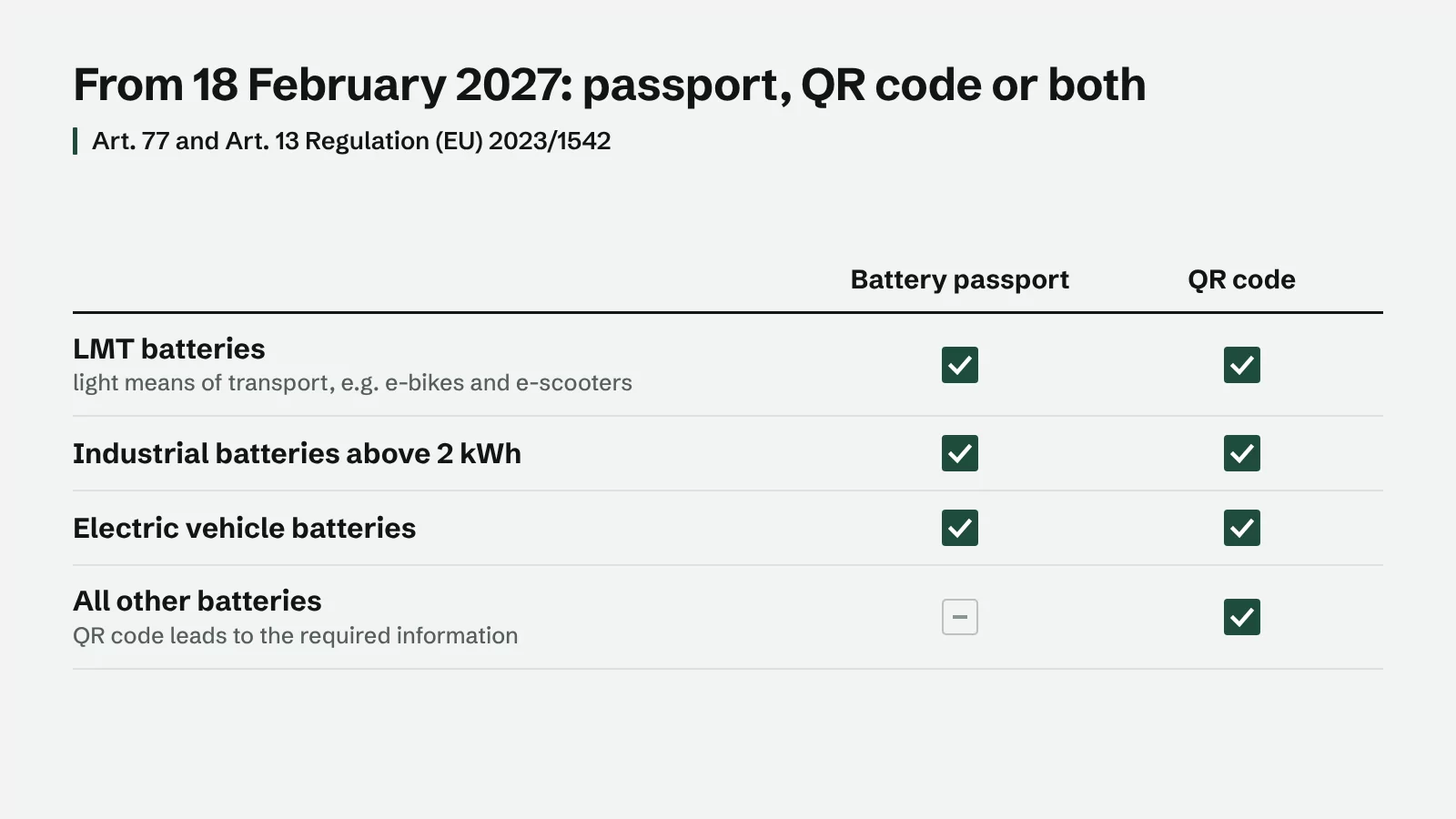
From 18 February 2027, LMT batteries, industrial batteries above 2 kWh and electric vehicle batteries need an electronic battery passport (Art. 77(1) Regulation (EU) 2023/1542). Every battery carries a QR code (Art. 13(6)). Portable batteries, SLI batteries and industrial batteries up to 2 kWh only need the code, which then leads to required information rather than a passport.
Art. 77(1) and Art. 13(6) Regulation (EU) 2023/1542
Who needs what
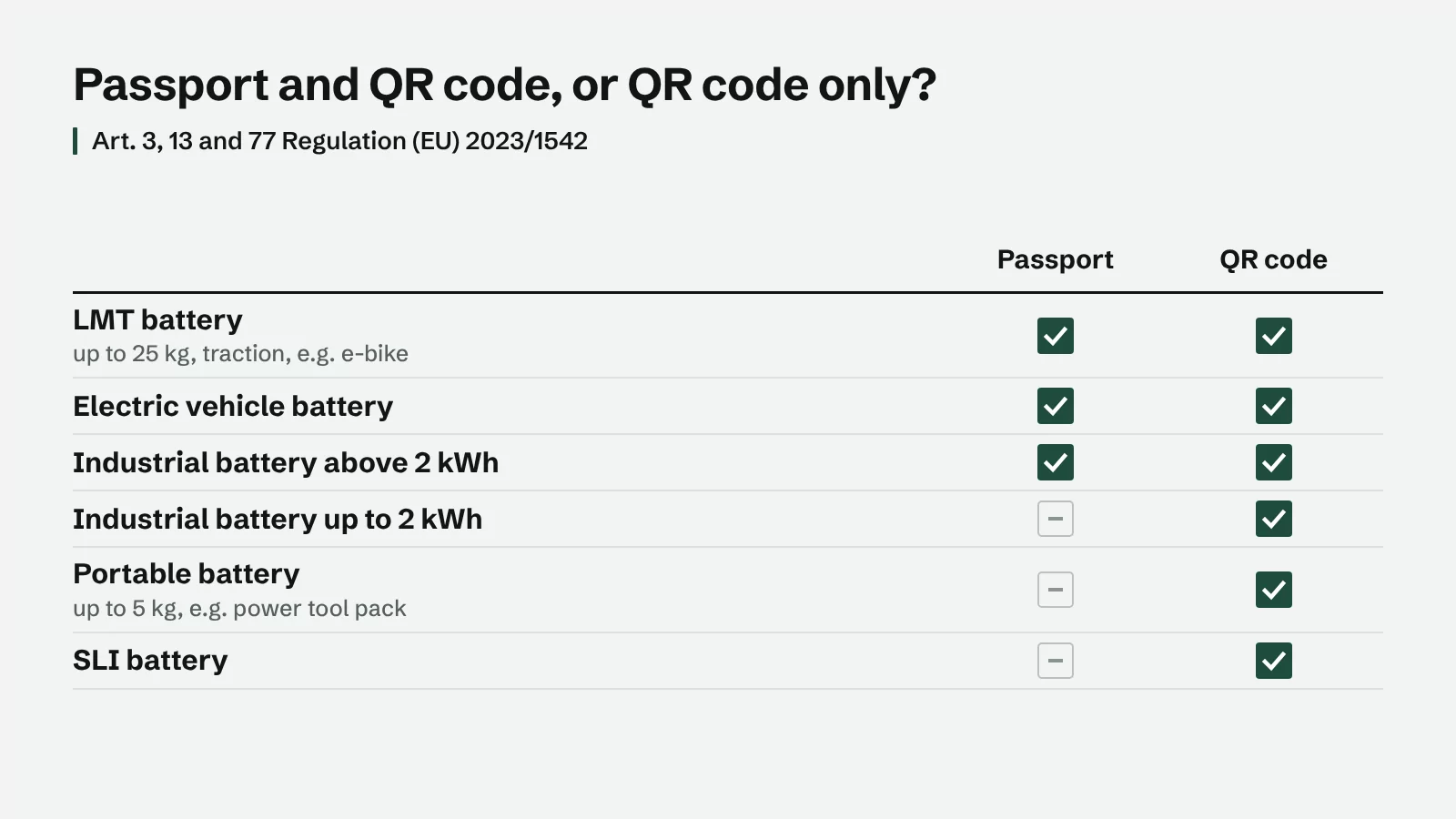
The battery category decides, not the appliance. The weight limits are in the definitions (Art. 3(1)).
- LMT battery (sealed, up to 25 kg, powering wheeled vehicles such as e-bikes and e-scooters): passport and QR code
- Electric vehicle battery (traction in category M, N or O vehicles, or category L above 25 kg): passport and QR code
- Industrial battery above 2 kWh: passport and QR code
- Industrial battery up to 2 kWh: QR code only
- Portable battery (sealed, up to 5 kg, not designed specifically for industrial use), including most power tool packs: QR code only
- SLI battery: QR code only, plus the share of recovered materials
What the passport contains
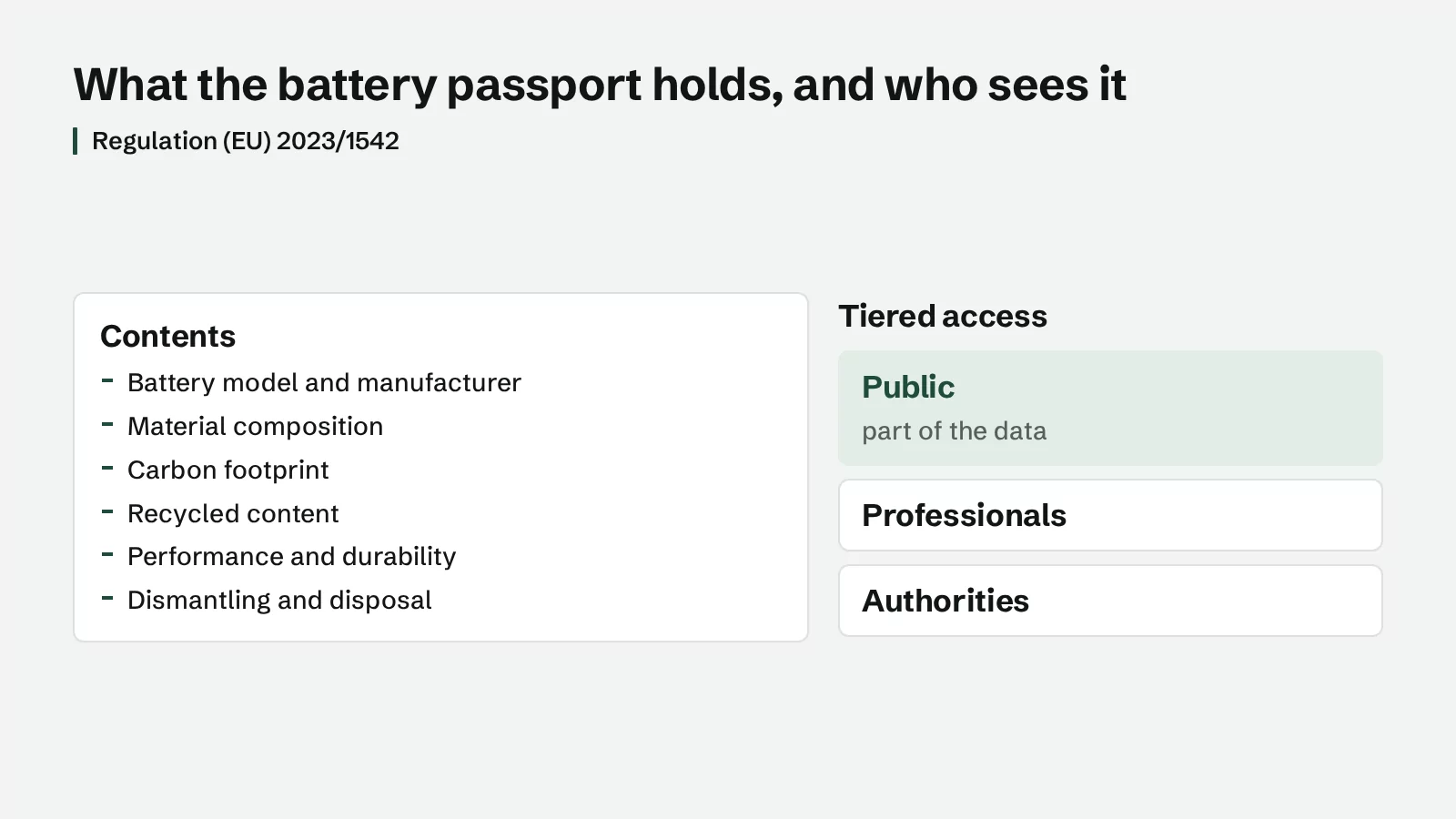
Annex XIII sorts the content by access. Public data about the battery model covers the Annex VI label data, material composition, carbon footprint, the due diligence report, recycled content, capacity, voltage, power, expected lifetime, the EU declaration of conformity and waste battery information. Other data is limited to persons with a legitimate interest, notified bodies, market surveillance and the Commission.
Not everything has to be filled in on the start date. According to the Commission’s guidance document (version 3.2, not binding), carbon footprint, the due diligence report and recycled content stay empty in February 2027.
The Commission’s battery page lists a document with the data points per category, last updated on 19 October 2026. It explains the duty and does not change it.
How passport and QR code fit together
The code links to a unique identifier that the operator assigns to each battery when placing it on the market (Art. 77(3)). Code and identifier follow ISO/IEC 15459-1 to 6 or equivalent standards. The identifier goes into the registry under Art. 13(1) of the Ecodesign Regulation (Art. 77(10)). The data has to be open, interoperable and machine-readable (Art. 77(5)).
A QR code that opens a PDF is therefore not a passport. For batteries without a passport duty, a page with the information listed in Art. 13(6)(b) is enough.
Is the date certain?
It is in the law, unchanged as of 2 November 2026. Art. 77(1) and Art. 13(6) of the consolidated text of 13 August 2026 both say 18 February 2027, and the Commission lists the date on its battery page. Art. 77 does not make the duty depend on any further act.
Details are open. The implementing act on persons with a legitimate interest was due by 18 August 2026 (Art. 77(9)); it has not been adopted. The draft has been out since 19 October 2026, with feedback until 16 November 2026. Procedure 2025/0397(COD) is running. The Commission’s proposal COM(2025) 981 and the Council mandate of 25 June 2026 do not change the passport or QR dates. Industry bodies such as EUROBAT and CECE are asking for a delay. Whether Parliament takes that up is open.
Who is responsible
Whoever places the battery on the market ensures the passport is accurate, complete and up to date, and may authorise another operator in writing (Art. 77(4)). Remanufactured or repurposed batteries get a new passport, and responsibility passes to whoever places them on the market again (Art. 77(7)).
What to do now
- Assign each battery model to a category and record why
- For passport batteries, choose a provider early and sort out supply chain data
- For all others, prepare the page behind the QR code per model
- Plan print approvals so the code is on the goods by 18 February 2027
Frequently asked questions
Who is responsible for the battery passport?
The economic operator who places the battery on the market (Art. 77(4)). That operator may authorise another in writing to act on its behalf.
Does the passport apply to batteries sold before 2027?
No. Art. 77(1) covers batteries placed on the market or put into service from 18 February 2027.
Does a cordless drill need a battery passport?
Normally not. A sealed pack up to 5 kg that is not designed specifically for industrial use is a portable battery. It needs the QR code but no passport. Check the classification of the actual pack.
Does an e-bike battery need a battery passport?
Yes, if it is an LMT battery: sealed, up to 25 kg and designed for traction (Art. 3(1)). The passport belongs to the battery and is reached through the QR code.
With ProofPass
For batteries without a passport duty, ProofPass already covers the QR code with the related documents. It does not provide the full battery passport for LMT, industrial and electric vehicle batteries. Specialised providers do that.
The dashboard and the sign-up form are in German.
Sources
- Regulation (EU) 2023/1542, consolidated text of 13 August 2026
- Regulation (EU) 2023/1542 (Battery Regulation)
- Proposal COM(2025) 981 amending the Battery Regulation
- European Parliament: procedure 2025/0397(COD)
- European Commission: batteries and battery passport
- Regulation (EU) 2024/1781 (Ecodesign for Sustainable Products Regulation, ESPR)
As of 3 November 2026. The legal text in force prevails. This page is not legal advice; sources are given above.