Battery QR code from 18 February 2027: which batteries, what information
As of · sourced from primary law · not legal advice · Auf Deutsch lesen
This English version was prepared with AI from the German page. No native speaker or lawyer has read it. Found a mistake? Write to office@proofpass.eu.
The short answer
From 18 February 2027 every battery carries a QR code (Art. 13(6) Regulation (EU) 2023/1542). For LMT, electric vehicle and industrial batteries above 2 kWh it leads to the battery passport. For all others it leads to labelling data, the declaration of conformity, the due diligence report and waste battery information. A 2025 amending proposal leaves this date untouched.
Art. 13(6) and (7) Regulation (EU) 2023/1542
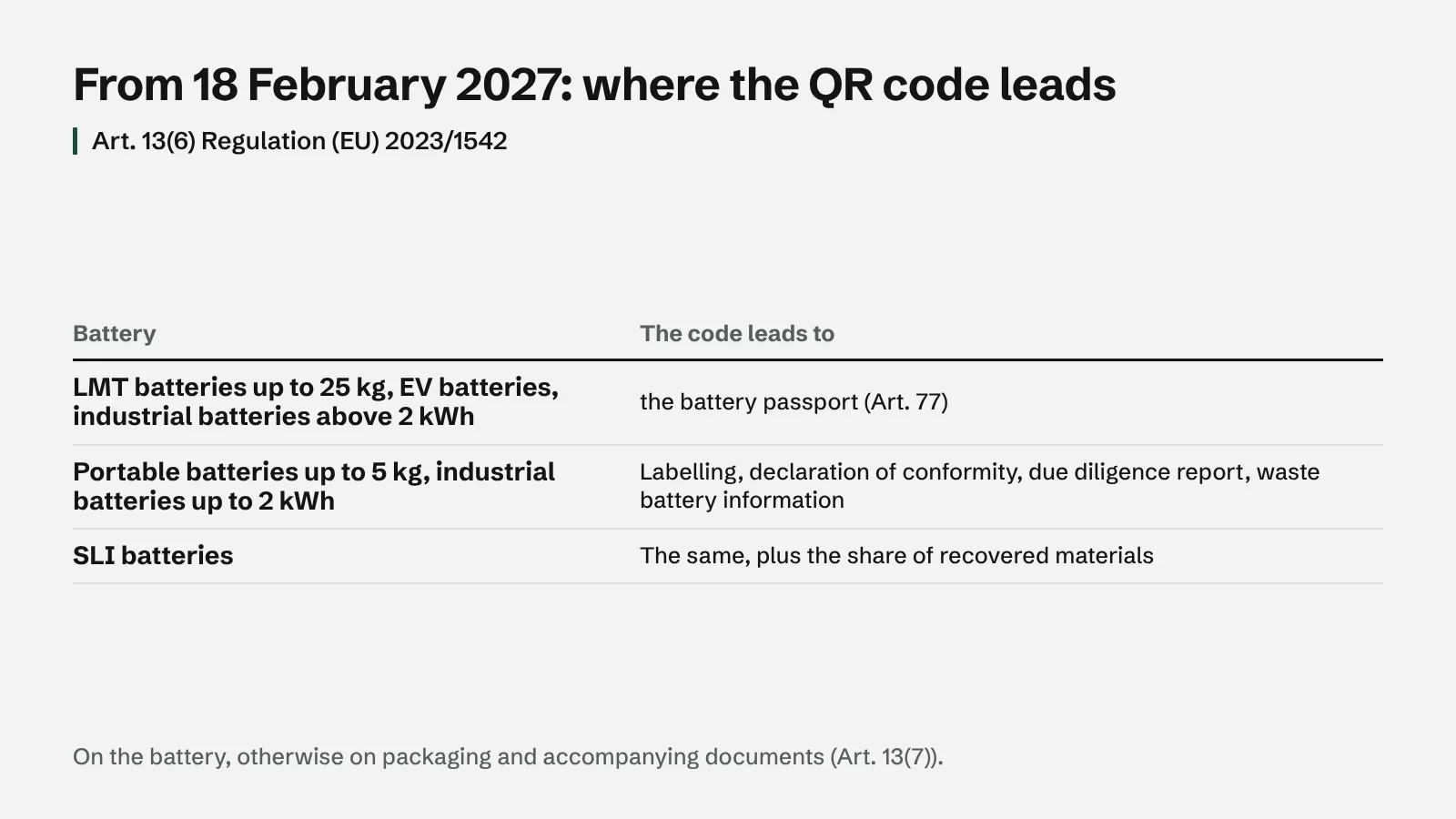
Which batteries need a code
All of them. The Regulation covers all categories, including batteries built into products and those designed to be (Art. 1(3)). What sits behind the code depends on the category.
- LMT batteries (sealed, up to 25 kg, powering wheeled vehicles such as e-bikes): battery passport
- Electric vehicle batteries: battery passport
- Industrial batteries above 2 kWh: battery passport
- Portable batteries (sealed, up to 5 kg, not designed specifically for industrial use): information under Art. 13(6)(b)
- SLI batteries: information under point (b), plus recovered cobalt, lead, lithium or nickel content (point (c))
- Industrial batteries up to 2 kWh: information under point (b)
What sits behind the code when there is no passport
Art. 13(6)(b) names four blocks. The information must be complete, up to date and accurate.
- the applicable labelling information under Art. 13(1) to (5)
- the EU declaration of conformity under Art. 18
- the due diligence report under Art. 52(3)
- information on waste prevention and waste batteries under Art. 74(1), points (a) to (f)
Where the code goes and what it looks like
The code is printed or engraved visibly, legibly and indelibly on the battery (Art. 13(7)). Where the nature and size of the battery do not allow or warrant this, it goes on the packaging and accompanying documents. Annex VI Part C asks for high contrast and a size that a phone’s reader handles easily.
Remanufactured or repurposed batteries get new markings, and the change of status can be read through the code (Art. 13(9)).
Why sources mention two dates
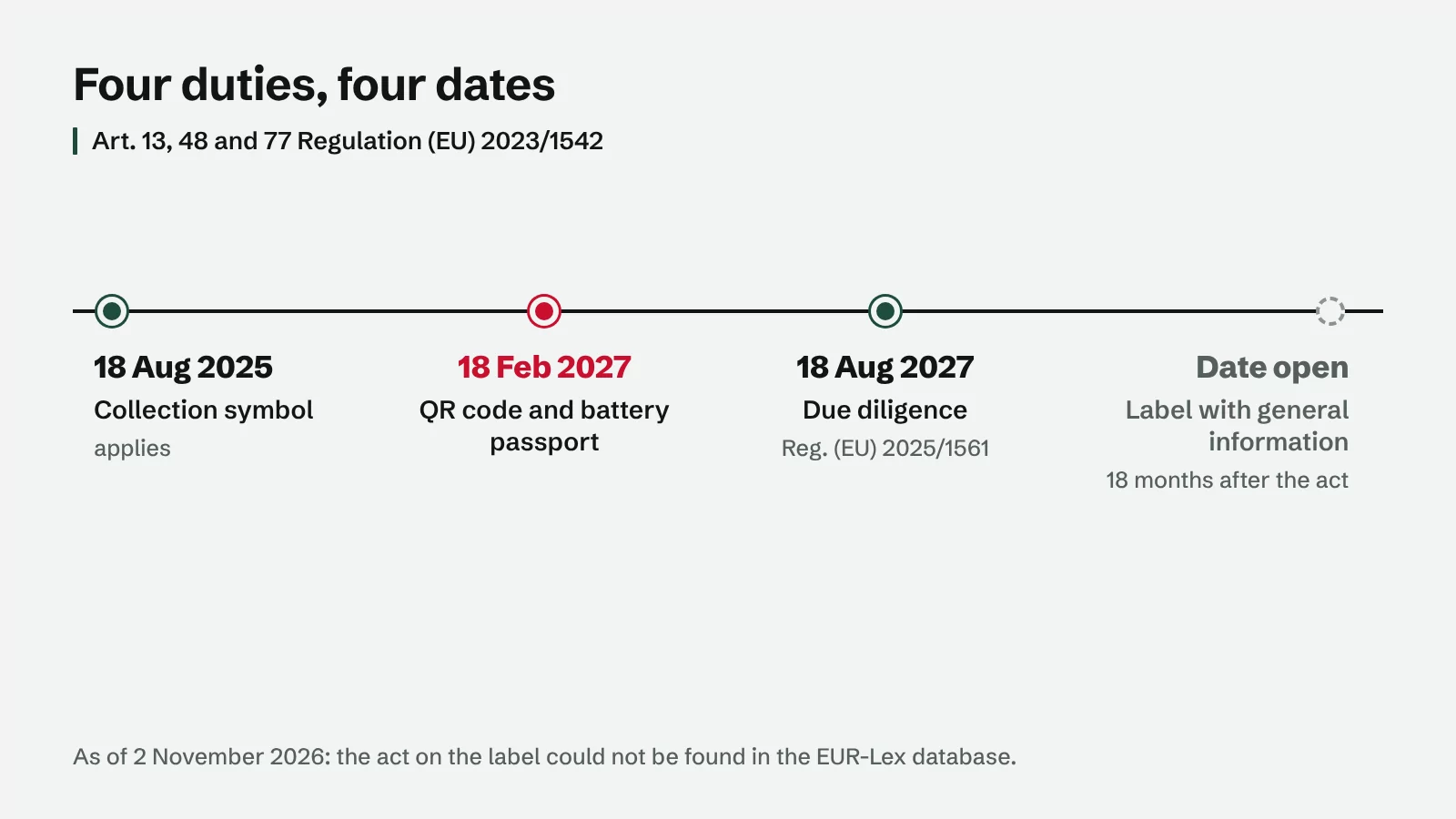
18 February 2027 applies to the QR code and is fixed in the article. The label with general information (manufacturer, category, weight, capacity, chemistry and more, Annex VI Part A) has a different date: 18 August 2026 or 18 months after the implementing act under Art. 13(10) enters into force, whichever is later. That act was due by 18 August 2025.
We did not find it in the EUR-Lex database on 2 November 2026, so the label does not apply yet. The separate collection symbol has applied since 18 August 2025 (Art. 13(4)), the Cd and Pb marks according to content (Art. 13(5)).
That leaves an open question: the QR code is meant to show the “applicable” information under paragraphs 1 to 5, while paragraphs 1 to 3 do not apply yet. Our reading is that on 18 February 2027 you show what already applies and what you have. Due diligence duties only start on 18 August 2027 (Art. 48(1)). We have not found an official answer.
Will the date move?
As of 3 November 2026, no. The consolidated text of 13 August 2026 says 18 February 2027 in Art. 13(6). Regulation (EU) 2025/1561 only postponed due diligence. The Commission’s proposal COM(2025) 981 does not touch the QR code in Art. 13 and changes Annex VI only for substances of very high concern.
The Council mandate of 25 June 2026 (doc. 11147/26) does redraft Art. 13(6). The date stays. For batteries without a passport, the information under paragraphs 1 to 5 would follow only 18 months after the implementing act. That is a negotiating position, not law.
The procedure is running. According to Parliament, its environment committee is due to vote in early November 2026 and first reading in plenary is pencilled in for 14 December 2026. Industry bodies such as CECE and EUROBAT want a delay. Those are requests, not law. Plan for 18 February 2027 and check the status before printing.
Who is responsible
The manufacturer marks the battery under Art. 13 (Art. 38(1)). Importers and distributors check the marking before selling (Art. 41(2), Art. 42(2)). If you build batteries into your appliance, agree with your battery supplier who provides the code and who maintains the page behind it.
What to do by 18 February 2027
- Assign each battery to a category. The 5 kg and 25 kg limits often decide.
- Reserve space on battery or packaging and test readability with a phone.
- Collect declaration of conformity and waste battery information per model.
- Set an address that stays. The code is printed, the page behind it changes.
- Agree in writing with suppliers who provides what.
Frequently asked questions
Is a QR code on the packaging enough?
Only where the nature and size of the battery do not allow or warrant marking it. Then the code goes on the packaging and accompanying documents (Art. 13(7)). The battery itself is the default.
Does the QR code have to follow a standard?
For the battery passport, yes: code and identifier comply with ISO/IEC 15459-1 to 6 or equivalents (Art. 77(3)). For other batteries, Annex VI Part C only sets contrast and readability.
Does every single battery need its own code?
For the passport, the code links to a unique identifier per battery (Art. 77(3)). For other batteries, Art. 13(6) sets no individual identifier; the information there concerns the model.
What about batteries produced before the date?
Art. 77 expressly names batteries placed on the market or put into service from that date. Art. 13(6) only says “all batteries”. We read it as also turning on placing on the market. We did not find an express transition rule in the text.
With ProofPass
For batteries without a passport duty, ProofPass fits this QR code: you store the declaration of conformity and notices on the product, the page behind the code always shows the current version, and the address stays. It does not provide the full battery passport with individual identifiers.
The dashboard and the sign-up form are in German.
Sources
As of 3 November 2026. The legal text in force prevails. This page is not legal advice; sources are given above.