Digital product passport: deadlines, product groups, what to prepare
As of · sourced from primary law · not legal advice · Auf Deutsch lesen
This English version was prepared with AI from the German page. No native speaker or lawyer has read it. Found a mistake? Write to office@proofpass.eu.
The short answer
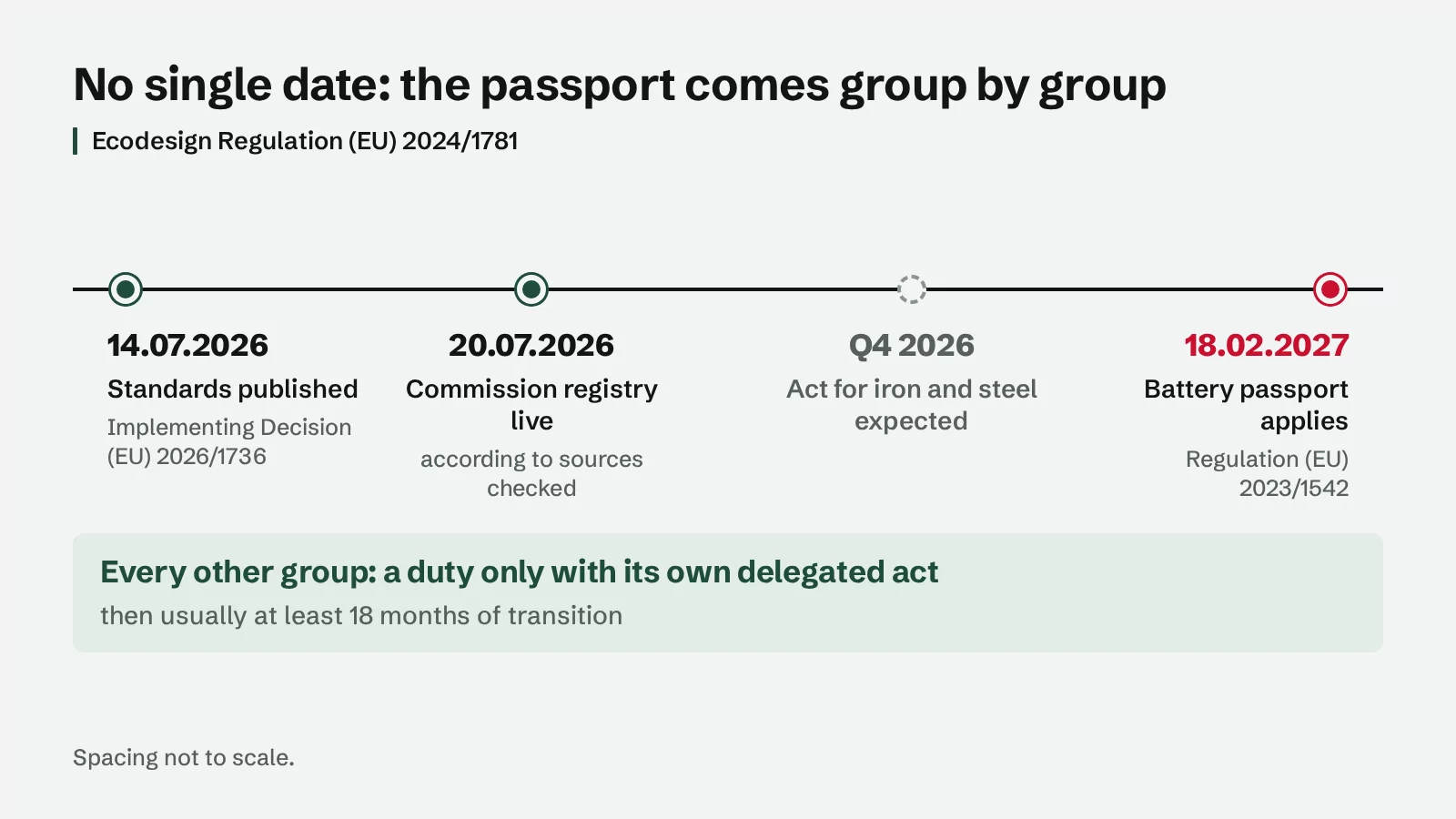
The digital product passport is an electronic record for a product, reached through a data carrier such as a QR code. Its basis is the Ecodesign for Sustainable Products Regulation (EU) 2024/1781. A duty arises only with a delegated act for your product group, usually followed by at least 18 months of transition. The first passport to apply is the battery passport, from 18 February 2027.
Regulation (EU) 2024/1781 (ESPR)
What the passport contains
The act for each product group decides which data a passport holds. Typical are details on materials and substances of concern, carbon footprint, repairability, recycled content, conformity documents, instructions for use and disposal.
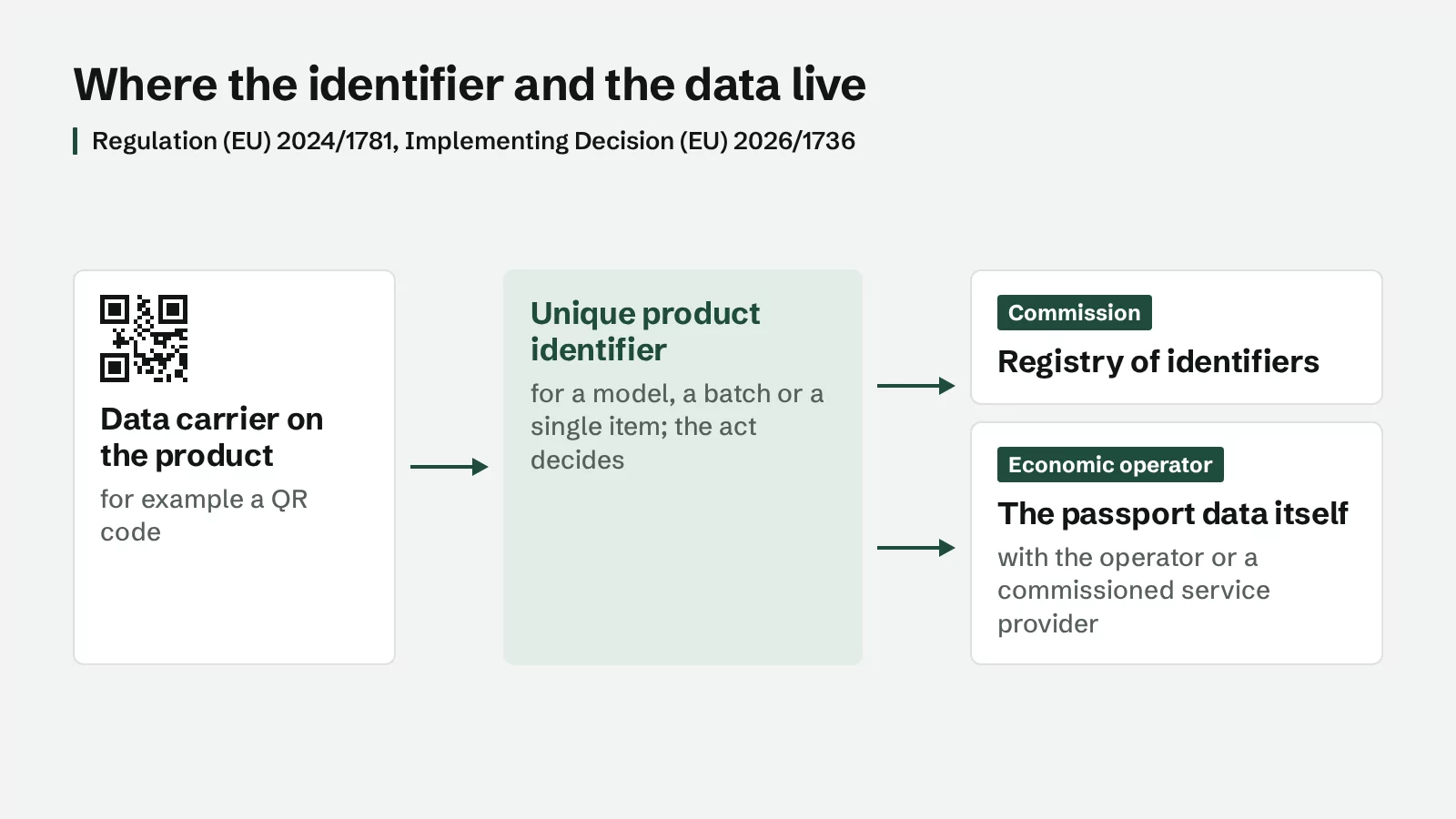
You reach the passport through a unique product identifier. It can refer to a model, a batch or a single item. The act decides that too.
Registry and standards
The Commission runs a registry for the identifiers of product passports. According to the sources we checked, it has been live since 20 July 2026. The passport data itself stays with the economic operator or a service provider the operator has commissioned. We have not verified the registry’s start date against the primary text.
The Commission published the standards for identifiers, data carriers, interfaces and data access with Implementing Decision (EU) 2026/1736 of 14 July 2026.
Which product groups come first
The Commission’s 2025–2030 working plan names iron and steel, aluminium, textiles, tyres, furniture and mattresses as priorities, plus cross-cutting requirements for electrical equipment (repairability, recycled content). The act for iron and steel is expected in the fourth quarter of 2026. By October 2026, as far as our research shows, no product-specific act under the ESPR had been adopted.
Article 18 ESPR names detergents, paints and lubricants as priority groups, but the 2025-2030 working plan leaves them out. Detergents get a passport through their own Regulation (EU) 2026/405, construction products through the Construction Products Regulation.
What you can do now
Rather than wait for a general deadline, prepare the parts every group will need.
- Collect product data in one place: data sheets, declarations and certificates per product, with versions
- Give every product a permanent address and a QR code that survives a website relaunch
- Assign GTINs where you have them: GS1 Digital Link is the obvious route to a unique identifier
- Follow the acts for your product group instead of waiting for a general date
Frequently asked questions
Is there a single date for the product passport?
No. Each product group gets its own act with its own date. Batteries are first, from 18 February 2027. For iron and steel the act is expected at the end of 2026.
May a service provider host the passport?
Yes. The ESPR provides for service providers. The economic operator who places the product on the market stays responsible for the accuracy of the data.
Does the passport concern small companies?
In principle yes, if your product group is covered. Some duties in the Regulation exempt micro and small enterprises, such as the ban on destroying unsold clothing and footwear. For the passport itself the respective act decides.
With ProofPass
ProofPass tracks each duty per product group with date, status and legal source (German deadline tracker) and gives every product the permanent address a passport will hang from.
The dashboard and the sign-up form are in German.
Sources
- Regulation (EU) 2024/1781 (Ecodesign for Sustainable Products Regulation, ESPR)
- European Commission: Ecodesign for Sustainable Products Regulation
- European Commission: Digital product passport for iron and steel
- Implementing Decision (EU) 2026/1736 (standards for the digital product passport)
- Regulation (EU) 2023/1542 (Battery Regulation)
- Regulation (EU) 2026/405 (detergents)
As of 5 November 2026. The legal text in force prevails. This page is not legal advice; sources are given above.