PPWR since 12 August 2026: what applies and what is still pending
As of · sourced from primary law · not legal advice · Auf Deutsch lesen
This English version was prepared with AI from the German page. No native speaker or lawyer has read it. Found a mistake? Write to office@proofpass.eu.
The short answer
The PPWR has applied since 12 August 2026 (Art. 71 Regulation (EU) 2025/40). Manufacturer and importer duties, PFAS limits for food-contact packaging and the heavy metal limit now apply. The harmonised label comes 24 months after the implementing acts. They are missing, so by our count after 3 November 2028. Minimisation, recycled content and format bans come from 1 January 2030 at the earliest. Many details depend on pending acts.
Art. 71 Regulation (EU) 2025/40
What has applied since 12 August 2026
Art. 71 sets the start. Where a provision names no date of its own, the Commission’s FAQ says this date applies.
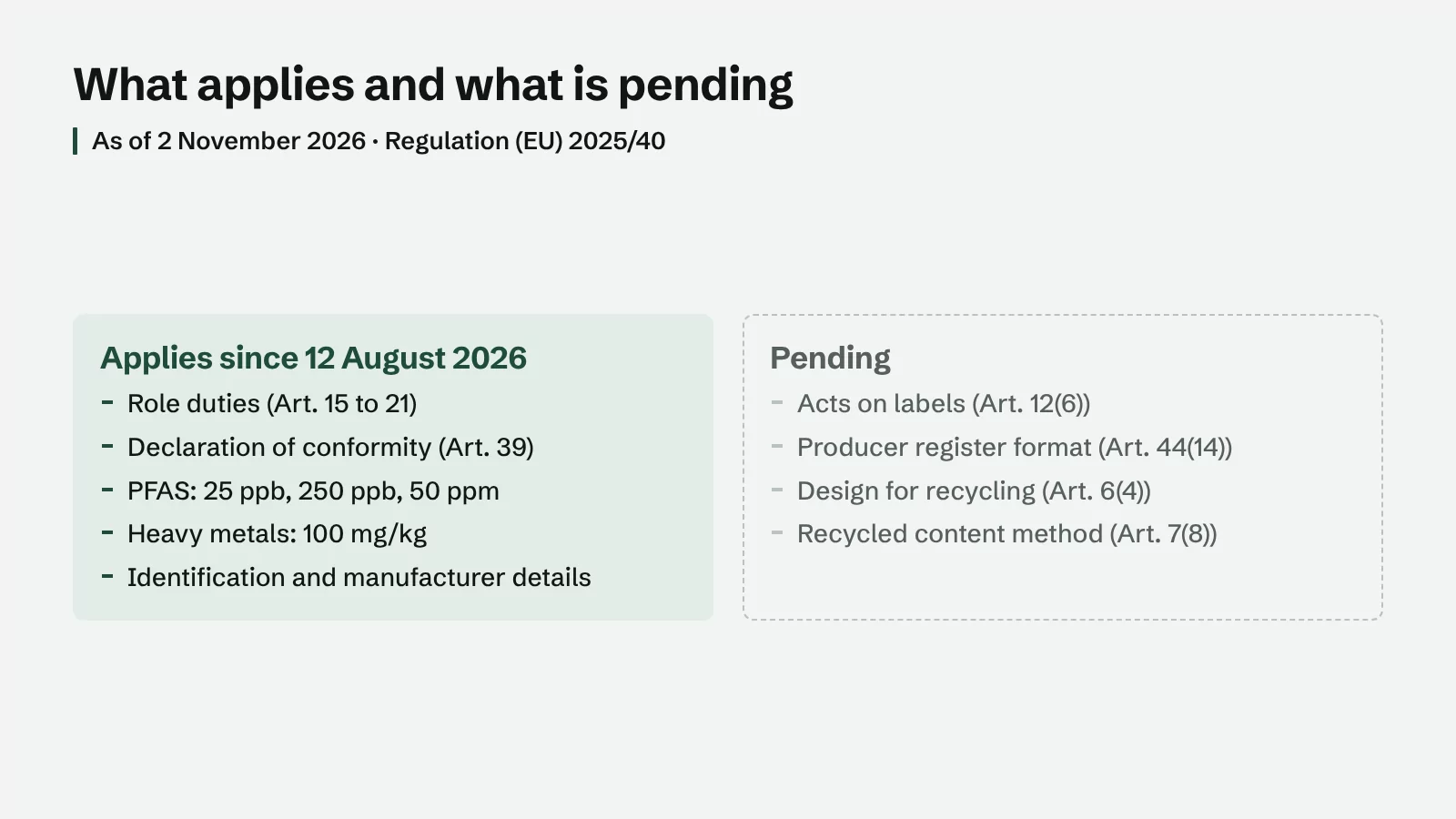
- Duties of manufacturers, suppliers, importers, distributors and fulfilment service providers (Art. 15 to 21)
- Conformity assessment, technical documentation and EU declaration of conformity for the requirements already in force (Art. 38, 39, Annexes VII and VIII)
- Food-contact packaging: PFAS below 25 ppb for any single PFAS, 250 ppb as a sum and 50 ppm in total (Art. 5(5))
- All packaging: at most 100 mg/kg of lead, cadmium, mercury and hexavalent chromium combined (Art. 5(4))
- Identification on the packaging, otherwise in the accompanying documents (Art. 15(5))
- Manufacturer name and address on the packaging, on a QR code or another data carrier, otherwise in the accompanying documents (Art. 15(6))
What happens to stock
The Regulation has no sell-through period for PFAS. The guidance turns on placing on the market: what was placed before 12 August 2026 stays on the market, what is placed later must meet the limits. For food sales and grouped packaging that is generally filling, for imports the release for free circulation.
Packaging already produced but not yet placed on the market need not be destroyed or relabelled, says the FAQ. Identification and manufacturer details may go in an accompanying document.
What applies later
The dates are in the individual articles. Where it says “or”, the later date applies.
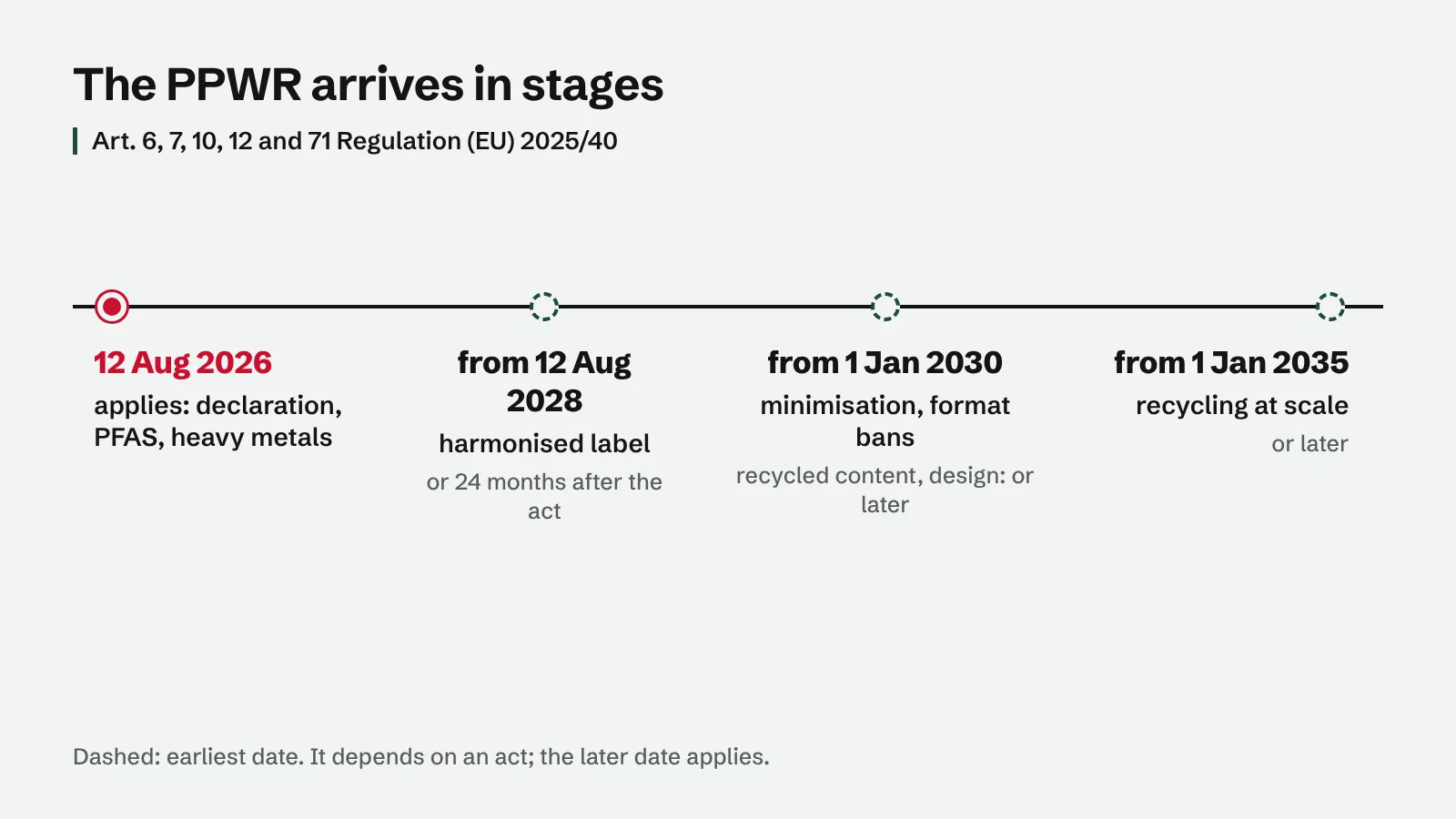
- 12 August 2028 or 24 months after the implementing acts: harmonised label on material composition (Art. 12(1)). The acts were missing on 3 November 2026, so by our count after 3 November 2028
- 12 February 2029 or 30 months after the act: label for reusable packaging (Art. 12(2)). By our count after 3 May 2029
- 1 January 2030: minimisation (Art. 10), format restrictions (Art. 25), re-use targets for transport packaging (Art. 29)
- 1 January 2030 or three years after the act: minimum recycled content in plastic (Art. 7), empty space ratio of at most 50 % (Art. 24)
- 1 January 2030 or 24 months after the delegated act: design for recycling (Art. 6(2)(a))
- 1 January 2035 or later: recycling at scale (Art. 6(2)(b))
Recyclability: a duty on paper, assessment later
Art. 6(1) requires recyclable packaging without a date of its own, so according to the guidance it applies from 12 August 2026. You do not need an Art. 38 conformity assessment for recyclability until the delegated act under Art. 6(4) applies. Until then the previous requirements of Directive 94/62/EC remain the benchmark.
The Commission is due to adopt that act by 1 January 2028. Minimisation works the same way: the previous essential requirements and standard EN 13428:2004 remain the reference until the end of 2029 (Art. 70(1)(b)).
What is still pending
The Regulation gives the Commission many follow-up acts. The guidance speaks of the coming two to three years. Acts on labelling were due by 12 August 2026 (Art. 12(6)), the producer register format by 12 February 2026 (Art. 44(14)). We found neither in the EUR-Lex database on 2 November 2026.
Published so far: guidance document C/2026/3084 of 10 June 2026, an FAQ of August 2026, the exemption for pallet wrappings and straps from the full re-use targets (Delegated Decision (EU) 2026/429) and a change on crystal glass (Delegated Decision (EU) 2026/1948).
The producer register follows within 18 months of the first implementing act (Art. 44(1)). According to the Commission’s FAQ, producers first report under the new rules by 1 June 2030.
What to do now
- Test food-contact packaging for PFAS and file the reports with the technical documentation.
- Issue a declaration per format and state which requirements it covers today.
- Make sure new packaging carries identification and manufacturer details.
- Plan labels and recycled content for 2028 to 2030, but do not place a large print order before the acts are out.
- Recheck the dates each quarter: many depend on the date of an act.
Frequently asked questions
Was the PPWR postponed?
No. Art. 71 says 12 August 2026, and the Commission announced the start of application on 11 August 2026. Individual duties only appear postponed because they depend on the date of a follow-up act.
Does the PPWR cover goods that have nothing to do with packaging?
Yes, through their packaging. It covers all packaging, including the box your product ships in. Whoever fills it or sells under their own brand is normally the manufacturer of that packaging, whatever is inside.
Do I have to remove national labels now?
No, not because of 12 August 2026. The guidance says national labels may no longer sit alongside the harmonised one after its start date. By our count that is after 3 November 2028, because the acts are missing.
What applies on top in my country?
The PPWR applies directly in every Member State. We have not checked national reporting or penalty rules for this article. Ask your compliance scheme or the competent authority.
With ProofPass
ProofPass records which version of your declaration applied when, and always shows the current one on the product, at a fixed address and through a QR code. Test reports sit next to it. It does not do the assessment itself or file with producer registers.
The dashboard and the sign-up form are in German.
Sources
As of 3 November 2026. The legal text in force prevails. This page is not legal advice; sources are given above.