PPWR declaration of conformity: who issues it and who collects it
As of · sourced from primary law · not legal advice · Auf Deutsch lesen
This English version was prepared with AI from the German page. No native speaker or lawyer has read it. Found a mistake? Write to office@proofpass.eu.
The short answer
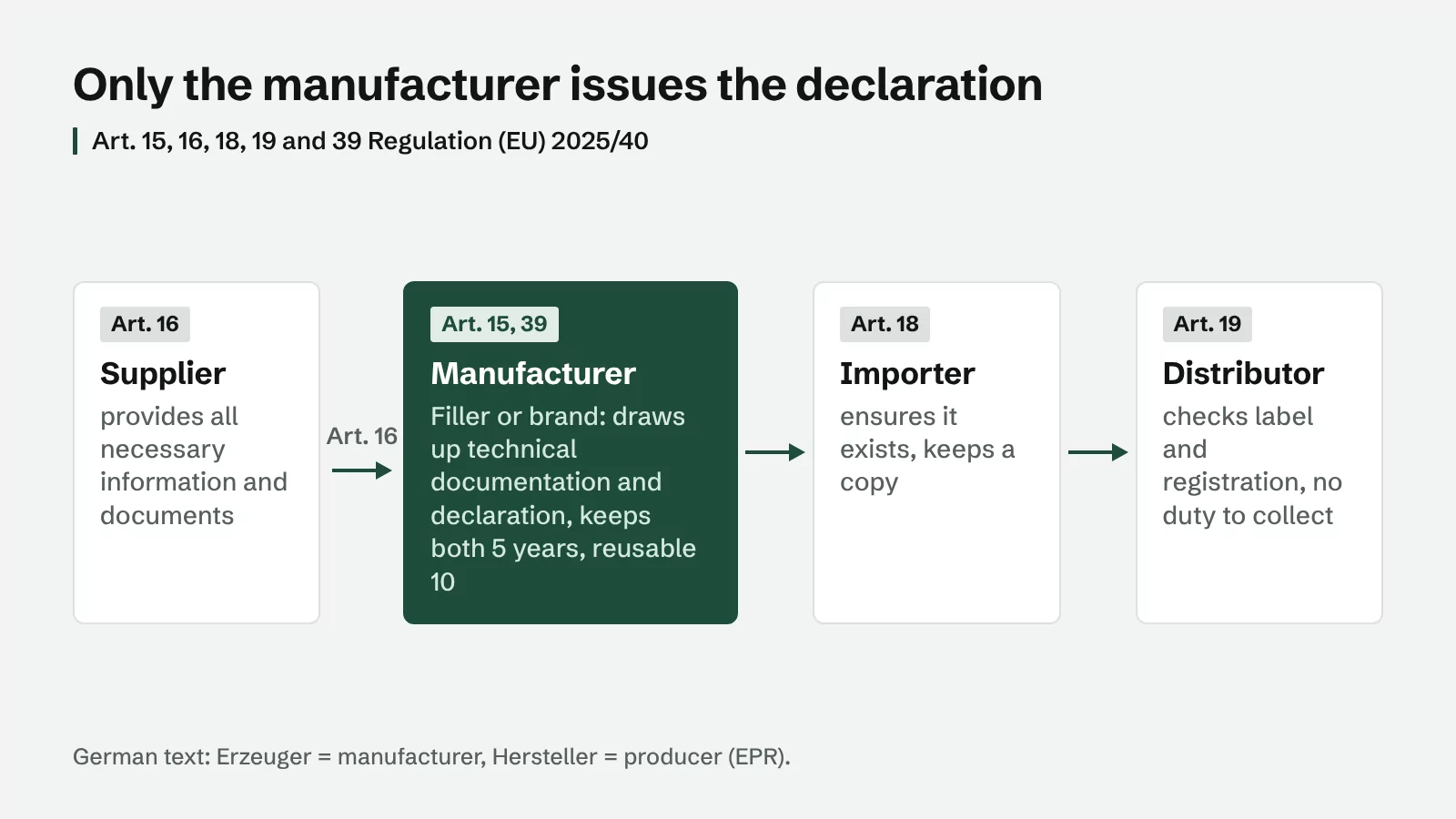
The manufacturer issues the EU declaration of conformity for packaging (Art. 15(2) and Art. 39 Regulation (EU) 2025/40). For sales packaging that is normally the filler or brand owner. Suppliers must provide the evidence (Art. 16). Importers check it and keep a copy. Distributors have no duty to collect it.
Art. 15(2) and Art. 39 Regulation (EU) 2025/40
Manufacturer and producer are two different roles
The PPWR separates the manufacturer (Art. 3(1)(13)) from the producer (Art. 3(1)(15)). The manufacturer is responsible for conformity. The producer carries extended producer responsibility: registration, reporting and fees. According to the Commission’s guidance there is one manufacturer EU-wide, and one producer per Member State.
German-language readers should note a trap: the German text calls the manufacturer “Erzeuger” and the producer “Hersteller”. Sources that disagree on who issues the declaration are often just translating differently.
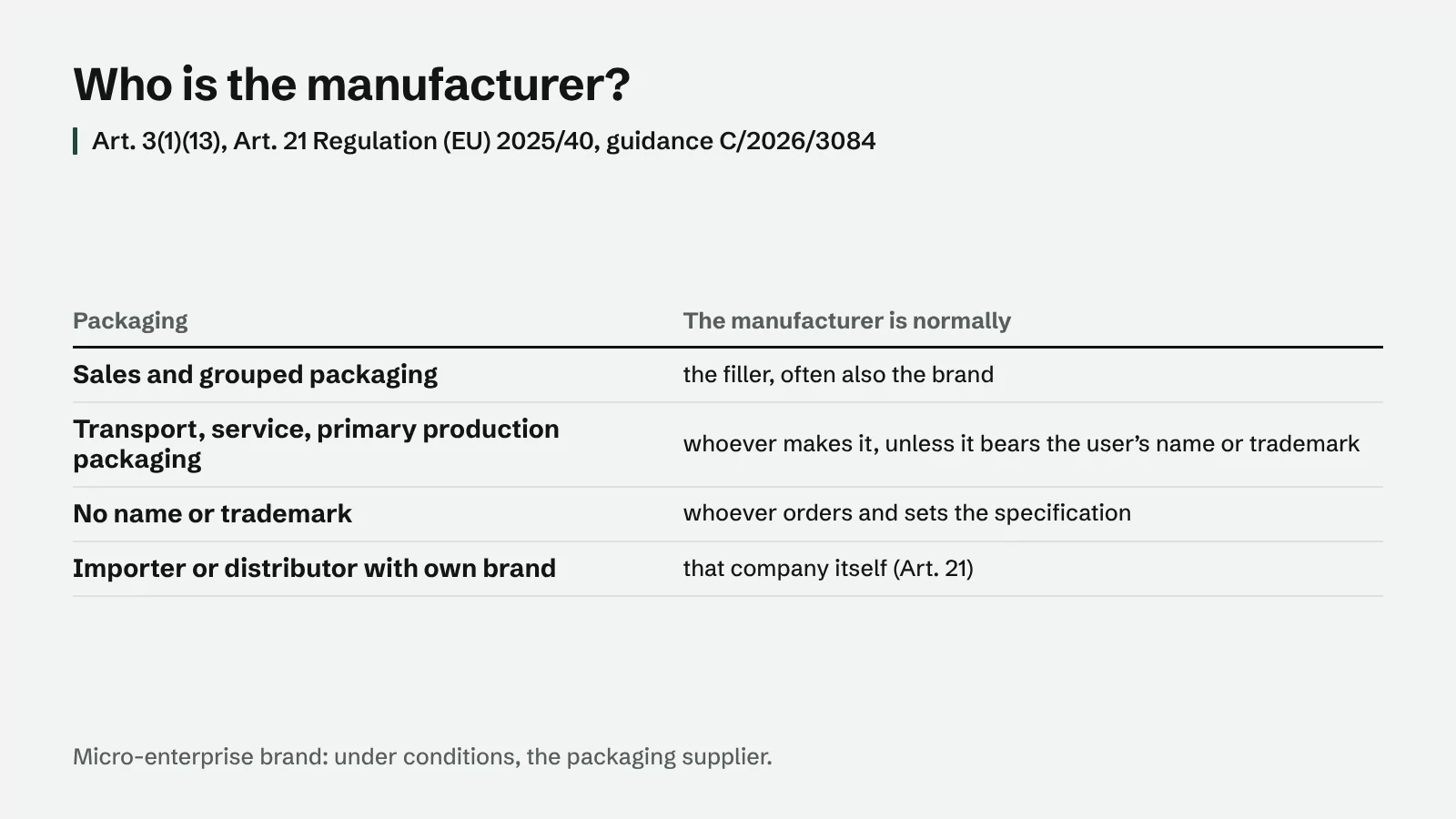
Who is the manufacturer?
It is not necessarily whoever physically makes the packaging. If you have packaging or a packaged product designed or made under your name or trademark, you are the manufacturer (Art. 3(1)(13)(a)). Guidance document C/2026/3084 applies this by packaging type.
- Sales and grouped packaging: normally the filler, often also the brand owner
- Transport, service and primary production packaging: normally whoever makes it, unless the user’s name or trademark is on it
- No name or trademark: whoever places the order and sets the design specifications
- Importer or distributor using its own brand, or modifying packaging in a way that could affect compliance: treated as the manufacturer (Art. 21)
- Micro-enterprise brand: under conditions, the packaging supplier (see the FAQ below)
Who supplies, checks or keeps what
The Regulation has no general duty to collect the declaration along the chain. Each role has its own narrower task.
- Supplier: gives the manufacturer all necessary information and documentation, on paper or electronically (Art. 16). The Commission’s FAQ says suppliers cannot refuse.
- Manufacturer: carries out or commissions the conformity assessment, draws up the technical documentation and the declaration, and assumes responsibility (Art. 15, Art. 39(4)).
- Authorised representative: may draft and keep the declaration under mandate, but cannot draw up the technical documentation (Art. 17). Responsibility stays with the manufacturer.
- Importer: ensures assessment and documentation exist, and keeps a copy of the declaration for the authorities (Art. 18(2) and (7)).
- Distributor: checks producer registration, labelling and the manufacturer and importer details before selling (Art. 19(2)). The declaration is not on that list.
- Fulfilment service provider: makes sure storage and shipping do not jeopardise compliance (Art. 20).
What the declaration contains
Annex VIII sets out eight points: identification of the packaging, name and address of the manufacturer, the sole responsibility statement, object of the declaration, Union law applied, standards and specifications, the notified body if any, and additional information. Then place, date, name, function and signature.
You need one declaration per packaging type (Annex VII point 4). The Commission’s FAQ reads “type” as the format or the batch or series, not the material types in Annex II. A packaging unit of bottle, closure and label gets one declaration that names all components. Keep it up to date and available in the language of the market (Art. 39(2)).
How long you keep it and for whom
Keep the declaration and technical documentation for five years for single-use packaging and ten years for reusable packaging, from placing on the market (Art. 15(3)). When an authority makes a reasoned request, the documents are due within ten days, electronically and on paper if asked (Art. 15(10)).
The Regulation does not require publishing the declaration. Where customers demand it, that comes from contracts, not from the PPWR.
Example: tile adhesive in a 25 kg sack
A construction chemicals company fills tile adhesive into sacks ordered from a packaging plant, with its brand printed on them (invented example). It is the manufacturer of the packaging. The plant is the supplier and provides material data and test reports. The DIY store is a distributor. It may ask for the declaration by contract, but the PPWR does not oblige it to collect one.
What to do now
- List your packaging by format or series, with components and suppliers.
- Decide who is the manufacturer per packaging. Sales packaging with your brand: you.
- Request the Art. 16 documents from suppliers and record when they arrive.
- Draw up the technical documentation and declaration under Annexes VII and VIII, in-house or with a test provider.
- Name who updates the declaration when packaging, supplier or standard changes.
Frequently asked questions
Does my retailer have to collect the declaration from me?
The PPWR does not require it. Art. 19(2) lists what distributors check: producer registration, labelling and manufacturer and importer details. Many retailers ask anyway, because they must act with due care (Art. 19(1)) and give authorities whatever they have access to (Art. 19(6)).
Can a lab or an agency do this for me?
In part. Someone else may carry out the conformity assessment, such as a laboratory. An authorised representative may draft the declaration under a written mandate. The technical documentation cannot be handed to the representative (Art. 17). According to the Commission’s FAQ, legal responsibility always stays with the manufacturer.
What about micro-enterprises?
If the brand is a micro-enterprise, the packaging supplier can be the manufacturer. The Regulation words the supplier’s location differently: Art. 3(1)(13) says the same Member State, Art. 15(12) says the Union. Guidance C/2026/3084 follows Art. 3. Check your own case.
What happens to packaging in stock?
Packaging placed on the market before 12 August 2026 may stay on the market. Packaging already produced but not yet placed on the market need not be destroyed, but it falls under the rules. According to the Commission’s FAQ, identification and manufacturer details may then go in an accompanying document.
With ProofPass
ProofPass does not write declarations, assess conformity or handle producer register filings. You store your finished declaration as a document on the product: with every version, a fixed address and a QR code. Customers who ask for it receive it through the distribution list, with delivery proof. From the Start plan you can ask suppliers for documents from the dashboard and see what is still missing.
The dashboard and the sign-up form are in German.
Sources
As of 2 November 2026. The legal text in force prevails. This page is not legal advice; sources are given above.